

September 7, 2026
•
8 min read
What Does Good Thought Leadership Look Like?
The harsh truth is that most "content" isn't thought leadership at all.
The harsh truth is that most "content" isn't thought leadership at all.
A few months ago, I sat down with a Head of Marketing at one of our multi-billion-dollar clients.
He asked me straight: "What does good thought leadership actually look like?
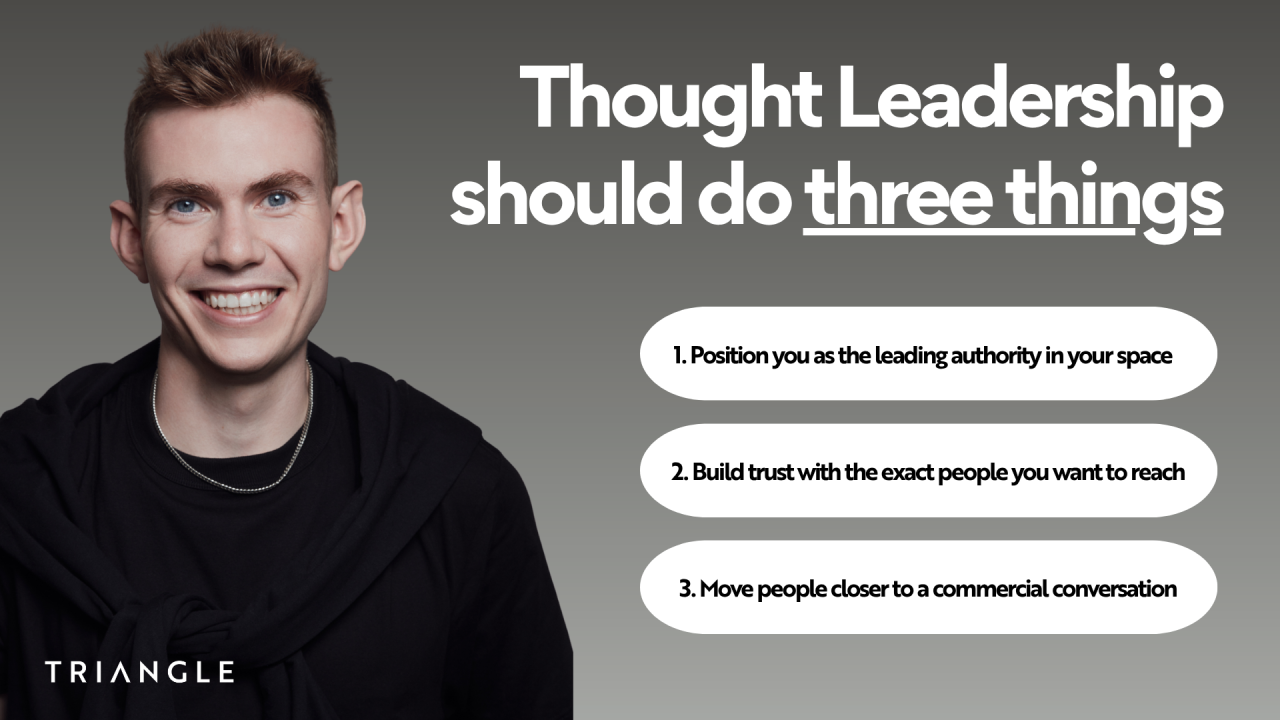
I said, Thought leadership should do three things:
- Position you as the authority in your space
- Build trust with the exact people you want to reach
- Move potential buyers closer to a real commercial conversation
Content fills the feed. Thought leadership moves you toward your strategic goals.
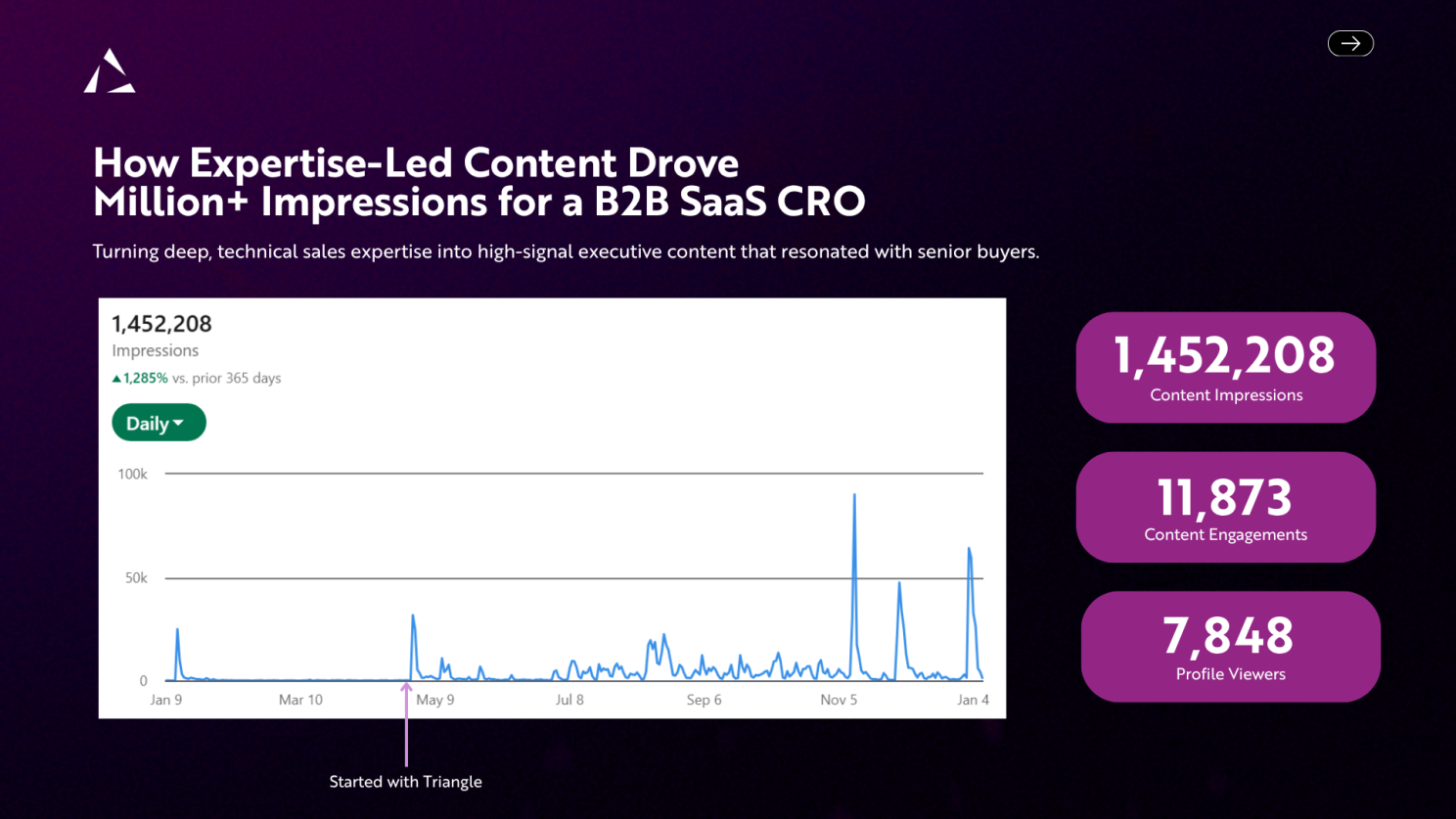
Take one of our clients, a CRO at a leading B2B company, where we took his deep technical sales expertise and turned it into content that reached senior buyers at scale. 1.4 million impressions. 1,285% increase working with us.
What thought leadership actually is
It decodes the shifts happening in your industry and explains why they matter.
It proves your edge, showing how you approach problems differently, backed by results.
It shares the decisions, frameworks and IP nobody else has access to.
It also takes a strong, original point of view.
It's all backed by data and identifies patterns before others do.
It puts words to what execs are already thinking but haven't said out loud, so you sound like one of them.
This is what builds true authority: when other people start referencing you, and you become the spokesperson of your industry, not just another voice adding to the noise in the feed.
I recently sat down with Andrew Monu (he/him), VP of Marketing at LinkedIn, and he put it perfectly:
"Sometimes people think about doing thought leadership in a self-promoting kind of way, that I am a thought leader. But actually, thought leadership is about helping people to be successful by shifting their perception in a direction that will make them successful.
“It's about helping them understand why they should trust you and how you can help them succeed. I don't think it's a standalone trophy. I think it's a purpose that helps customers be successful."

What thought leadership isn't
Your "thought leadership" post with zero original insight is just noise.
If ChatGPT could write it, why are you?
Generic life lessons. Recycled motivational quotes. Surface-level tips that could apply to any industry. Engagement bait. All of it gets impressions, but none of it builds reputation.
Good content gets people to like and comment.
Great content gets your ICP to pause and reflect.
Where AI fits
AI can accelerate a system you already run. It can't invent the system, your point of view, or your trust.
Use it for drafts, to stress-test an angle, or to repurpose something that's already working.
What it can't do: judge what's actually worth saying, draw on your lived experience, get your voice authentic, or build the go-to-market engine that sits around the post.
AI can amplify your voice. It can't be your voice, and definitely not your strategy.
Aim to change beliefs
Thought leadership changes beliefs. It doesn't hand out tips. The moments we remember most are the ones that shift what we believed.
Two things make that happen:
- An ‘aha moment' an insight or an unexpected truth that breaks old thinking.
- A curiosity gap, tension that makes someone want to know more.
Insight over inspiration, always. That's what drives meetings and pipeline.
Reach vs. relevance
If your content isn't bringing the right people into your inbox, it's not a visibility problem. It's a positioning problem.
Most content gets written for everyone: the algorithm, peers, old colleagues, etc. Not for the person who can actually change your business & build pipeline.
It comes down to what you're actually trying to achieve.
Some content should be designed for reach - getting an idea in front of as many eyes as possible. Success is defined by the new audience you reach.
Other content needs relevance, tapping into exactly what your ICP cares about right now, and positioning yourself as the trusted authority who can solve that specific problem. Success is defined by engagement from your target persona.
Get the balance right based on your overall strategic goals.
Consistency and quality game
The focus should be on the idea and the quality of the insight, not volume. It's about quality touch-points that move you toward your goals.
I often get asked how much content should be published? As a starting point, we recommend 12 to 15 posts a month. Focus on original insight and quality before volume, though.
You also need to play the consistency game so compounding takes place.
I like to think of it as building a brick wall.
Each post is a brick. One post on its own doesn't do much. BUT, if the bricks are stacked consistently on top of each other, that builds a wall. That wall is your market authority and all the trust in your industry.
Content that drives buyers, not just likes
LinkedIn isn't a content platform. It's a trust-building platform. If you're not increasing buyer confidence, you're doing it wrong.
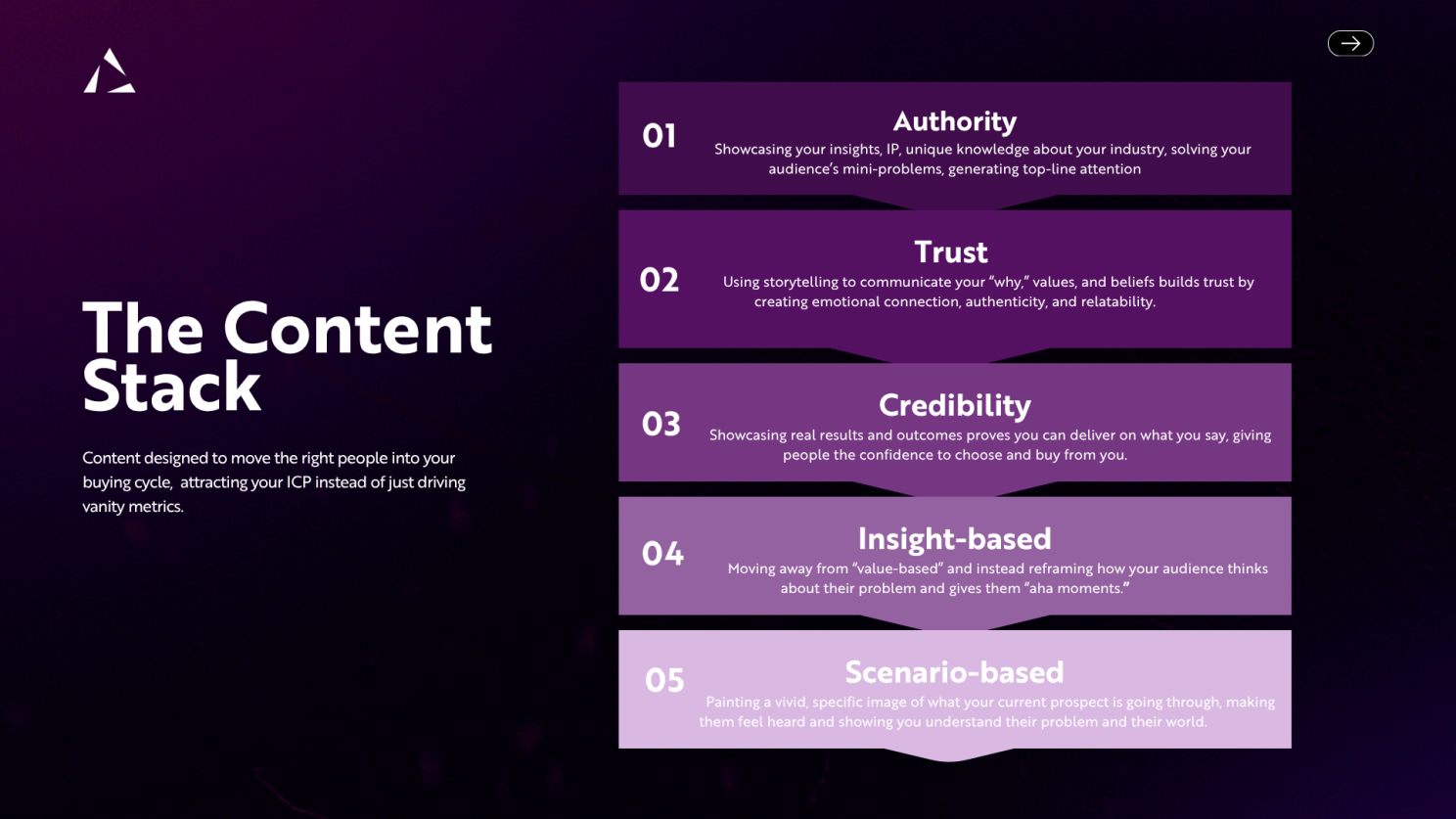
One of our core approaches: mapping your B2B sales process onto your content strategy.
Think of it like this:
- Authority gets their attention.
- Trust builds the emotional connection.
- Credibility proves you can deliver.
- Insight reframes how they think about the problem.
- Scenario-based content makes them feel understood.
Post nothing but credibility content, and you're pitching people who don't trust you yet. Post nothing but authority content and you never actually move anyone to buy.
This is how we think about true market positioning, the kind where someone would actually buy a six-figure deal from you, not just double-tap a post and scroll on.
Here's the gut-check to use: Does the quality of your thought leadership give someone the confidence to wire you $500k?
Logos are out, people are in
In terms of distributing your thought leadership content - the market's moving from logos to people.
Audience-first, trust-first, people-led content beats safe, institutional, company-page content every time.
Your buyer wants to know who's actually behind your business.
It's the same argument behind why a CEO's own profile will always outperform the brand page.
If you’re looking to get started with your own thought leadership – we offer complimentary strategy sessions to build out a plan with you.
Ready to Take Your Business to the Next Level With Triangle?
If you’re looking to generate millions of eyeballs on your business with your ideal audience, and book conversations with dream senior decision-makers — book a Strategy Consultation.

New York
Los Angeles
London

Founded by
Matt Swain
hello@triangle-branding.com